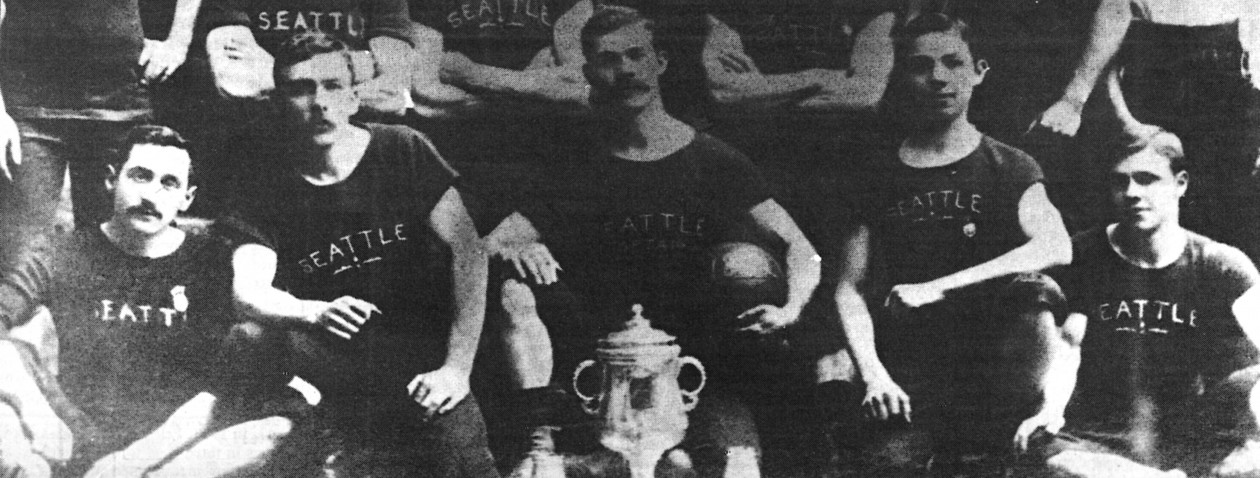
As his father tells the story, Walter Schmetzer beckoned Alan Hinton to watch his vaunted Lake City Hawks to watch a player of promise. But it wasn’t his son.
Still, as is often the case when coaches scout young (in this case U18) players, the original target can be eclipsed by another aspirant sharing the field, and that’s how on spring day in 1980 Brian Schmetzer’s long association with Puget Sound professional soccer began.
Schmetzer’s first turn as a Sounders head coach was from 2002-08.
Over 36 years since, Schmetzer has been associated as a player or coach with virtually every entity where one could draw a paycheck. Of the 500-some players who’ve worn a Seattle or Tacoma shirt over the years, Brian’s probably watched, played beside or coached an overwhelming majority of them.
For those who have grown to appreciate the Lamar Hunt U.S. Open Cup for its history, gritty displays and penchant for upsets, the Washington chapter can deliver on all those counts and more.
When Sounders FC pulls into the StubHub Center’s track venue for the quarterfinal date with the Galaxy, it will almost be like old, old times. Like when a Seattle side first ventured into southern California for a quarterfinal that, incidentally, was 50 years ago. Spoiler alert: Seattle did OK. That day, anyway. But more on that later.
At the ripe old age of 90, Mr. Lipton stands up straight, and though he shows signs of obvious wear there is a gleam to his appearance. Women with flowing hair, goddesses perhaps, flank him on either side.
Sir Thomas Lipton Trophy, made solid sterling silver, stands nearly three feet and was crafted 90 years ago.
Lipton’s got it pretty good. Folks take care of him, and he’s got a room with a view. Unlike his prime, he no longer gets out much, if at all, and the notion of young people picking him up and jubilantly hoisting him skyward is certainly out of the question. Still, with proper care and attention, there’s no reason to think Lipton won’t outlive us all.
Such is life for the stately Sir Thomas Lipton Trophy, likely among the oldest surviving artifacts of a rich soccer history that reaches back to the days before Washington’s statehood. Lipton and other sterling relics of their kind are hiding around the Seattle area, some of them in plain sight.
While the brightly-lighted Sounders FC trophy case on Occidental displays our biggest, brightest and most recent plunder–a Supporters’ Shield plus four Open Cups–the bulk of Washington’s historical treasures reside in a couple ordinary offices.
Sir Thomas Lipton, second from left, during his 1912 visit to Seattle Courtesy University of Washington Libraries)
Beyond the spectacle of it all–the crowd, the goals, the unlikely outcome–many of us came away from then-Qwest Field that brisk March night seven years ago believing we had found our next Mr. Sounder.
In 2009, Ozzie Alonso had pulled on the 6 shirt and instantly made it his own. For all the flash of the Rave jerseys, for all the flair exhibited by Fredy Montero, Seattle fans have always held their highest regard for a man with bite. A player who competes, who gives no quarter, who wins ball after ball and tackles hard. He makes the nuanced plays, the runs to open space and close down runners. He plays hard but stops short of becoming a hard man, at least from the home perspective.
Never backs down
Alonso covers acres of ground in each appearance, and last week’s Vancouver derby marked his 250th appearance for Seattle in all competitions.
There are those players whom we never wish to leave Sounderland, if only because we never wish to play or cheer against them. And yes, of course we love that sort of competitor.
Jimmy Gabriel, the original No. 6 and the original Mr. Sounder, never played for another U.S. club and has long made his home here, near the Sound. Nearly 40 years since his last tackle, we still love Jimmy.
Fresh-faced Ozzie, 2009
Sounders fans can’t imagine Alonso ever appearing in opposing colors. Yet during the past winter, we were given pause to contemplate just such a possibility. The untouchable tag was removed and Alonso’s name was dangled for all MLS to see. For me, the thought of seeing Ozzie in purple or orange or red was repugnant.
Thankfully, Alonso’s only offseason travel was the previously-thought-to-be impossible and emotional trip back to his island homeland. By first kick he was right back where he belonged, wearing the Rave Green 6 and in very fine form in the middle of the park.
Ozzie at 250
When the Honey Badger’s at the top of his game, he gives Seattle the best chance to win. Fans have rated him a solid 7 through the first five matches. Clearly, Alonso is not only back but performing as well as ever. Now if only the rest of the pieces can fall into place, the Sounders can begin climbing the table.
Seattle appreciates a ball-winner
While Zach Scott is the faraway leader in combined Sounders (USL and MLS eras) appearances, at 336 and counting, Alonso is the first to log 250 for any Seattle top flight entity. Scott Jenkins played 262 times in the A-League and USL-1.
Two-hundred fifty becomes all the more impressive when taking into account Alonso’s traits: increased mileage as a midfielder, tackling and his overall tenacity. Almost always he goes the full 90, full-on.
Without knowing whether the club marks these occasions with plaques or maybe a few platitudes in the locker room, it just feels right to acknowledge such a milestone, especially knowing the amount of commitment and passion Ozzie puts into it. Keep on doing your thing, Mr. Sounder, for many years to come.
He’s called well over a thousand games for the Huskies and long ago became a local broadcasting institution. But it may come as a surprise that Bob Rondeau cut his teeth on play-calling as the voice of the Sounders.
That’s right, before he first exclaimed “Touchdown, Washington!” came shouts of “Goooooooal, Sounders!”
Bob Rondeau has been the voice of Husky football since 1980 and UW men’s basketball since 1985. Courtesy UW Athletics.
Back in 1979, when KOMO AM-1000 added soccer to its stable of UW football and basketball, Rondeau stepped up to the mic with no experience in play-by-play and admittedly little knowledge of the game.
“I knew less than nothing about soccer,” says Rondeau. “I didn’t know a soccer ball from a cue ball.”
Whereas the next announcer will follow in some formidable footprints, for the original voice of the Sounders there simply was no trail. Bob Robertson blazed it himself.
Robertson, seen here in 1980, was a one-man crew in the booth. He called the original Sounders on radio and TV for eight of the 10 seasons.
“Up until (1974), as far as we knew, no one had broadcast soccer in America on a full-time basis,” remembers Robertson. “It hadn’t been done, other than a championship game in a small market. So we were pioneering.”
Robertson more than just broke ground. Already an established, respected pro, he helped grow the game’s audience and crowds with his rapid-fire, no-nonsense delivery, and he did so in a much more challenging environment that exists today. Robertson not only was the first, his tenure surpasses all followers, and he helped create a Sounders staple that thrives to this very day.
As daylight dwindles on 2015 and we seal this calendar’s time capsule, why not thumb through the best team performances, and determine which will best prevail against the test of time.
Some Washington sides made some remarkable accomplishments in the past year, and here are the best of the best:
Seattle United B98 Copa – In April they defeated Crossfire Premier to become the state’s first Dallas Cup champion, and the boys just kept going, winning the state and regional titles before reaching the USYSA U16 final match in July
Seattle Reign – First professional club to win back-to-back regular season league championships, going 13-3-4 in NWSL despite losing Hope Solo and Megan Rapinoe to national team duty for the better part of three months
Puget Sound women – Despite being eliminated in the Division III second round, the Loggers allowed only three (3) goals in 22 matches and became the state’s first unbeaten (17-0-5) women’s collegiate program Continue reading Washington’s 2015 Top Team Performances→
One the morning of Nov. 20, 1985, planes departed from the Midwest, Southern California and the East Coast carrying teams to Tacoma, Wash., for the NAIA Women’s Soccer Championships. They were all flying into what would become the strangest and one of the most controversial national finals in collegiate annals.
It was Thanksgiving Eve and by nightfall over a foot of snow would cover the grass of Baker Stadium on the University of Puget Sound campus. Semifinal games were slated to be played on that field two days later, posing a problem for Mike Jennings.
NAIA sponsored the first small-college championships for women’s soccer, beginning in 1984. Courtesy Mike Jennings.
It’s not as if Jennings needed more on his plate that Thanksgiving. He was the father of newborn twins earning around $3,000 as the Loggers’ coach. His role as tournament director was voluntary. He was also enrolled in the university’s physical therapy program.
Generally speaking, most longtime, web-footed residents of Puget Sound know the difference between autumn and winter: right, the rain is colder.
Other climate truths are that snow in the lowlands is uncommon. Still more exceptional are significant accumulations. And rarest phenomena of all are big, pre-Thanksgiving snowstorms followed by a week of sub-freezing temperatures.
A combination of two snowstorms and eight days of sub-freezing temperatures effectively paralyzed Puget Sound. Courtesy The News Tribune.
Thirty years ago, Washington was bit by just such a perfect storm, plus one more for good measure. And for two local colleges due to host late-round postseason matches, it brought about once-in-a-lifetime experiences for all who took part.
In 1985, Mike Jennings was in his second year as head coach of the University of Puget Sound women’s soccer program. His peers also elected him president of their NAIA coaches association and his Tacoma school was the approved host of the fledgling women’s semifinals and final.
Losses teach more lessons than victories, but it was difficult to know where to begin digesting what happened that day in Balboa Park.
For Mike Jones, it had been the perfect storm of adverse conditions. USF was unquestionably the stronger team and a deserving winner. But Washington had played strong Canadian programs such as Victoria and Simon Fraser and proved competitive. Earlier that season, the University of British Columbia had beaten the Dons, 3-1, prompting Jones to believe that on a given day, the Huskies might have earned a result.
“Looking at the two teams, it was probably a 3- or 4-nothing difference with us playing our best,” argues Jones. “Back then, other than the ethnic teams playing Sunday, it was all so new up here in the Northwest. When you got into games with college programs that had a lot of international players, it was hard to get much of the ball. I couldn’t see us scoring against (USF), but I think we could’ve held our own.”