Category Archives: Washington Huskies

One for All the Ages

When Washington’s winner bulged the back of the net, it was as if it was wired with an electrical charge capable of instantly zapping purple-clad alumni across the continent and back through the ages.

Not only was it pandemonium on the Washington bench but also in the rec rooms of UW players and coaches and fans spanning seven decades. Stabbing his close range shot between post and N.C. State keeper, Harry Bertos finally, after 63 seasons, pushed the Huskies over the hump and into the elite circle of NCAA champions on Dec. 15.

Ron Jepson, Washington’s first head coach, watches the Huskies’ NCAA championship celebration from Bellingham. (Courtesy Ron Jepson)

Scattered across the Northwest and nation were some 600 former players and coaches, now fans, who were watching the national final on their phones and rec room screens. Up in Bellingham, the UW men’s soccer program’s first coach spontaneously defied gravity.

“We jumped up off our seats,” exclaimed Ron Jepson of his family’s reaction. It was a “momentous occasion,” added Jepson, the coach of UW’s first varsity team. An engineering graduate student from England, he was handed Washington’s reins in October 1962, when the nearest collegiate competition was in Victoria and Vancouver.

Euphoria in Carolina

While Jepson was 2,947 miles away from the drama in Cary, N.C., Marty Rood was in the house at WakeMed Soccer Park. Rood, who played under Mike Ryan in the early Seventies, had flown from Seattle on the morning of the match, arriving in Raleigh a couple hours before kickoff, to join the scores of UW traveling fans dwarfed by the 10,000 cheering the hometown Wolfpack.

Rood stood alongside other alums spanning the seven decades of Husky soccer and found himself hoarse from support and celebrations going long into the night.

“This win was more euphoric than any in my years of soccer,” shared Rood. “It just didn’t seem they would lose…they just never gave up. They were relentless!”
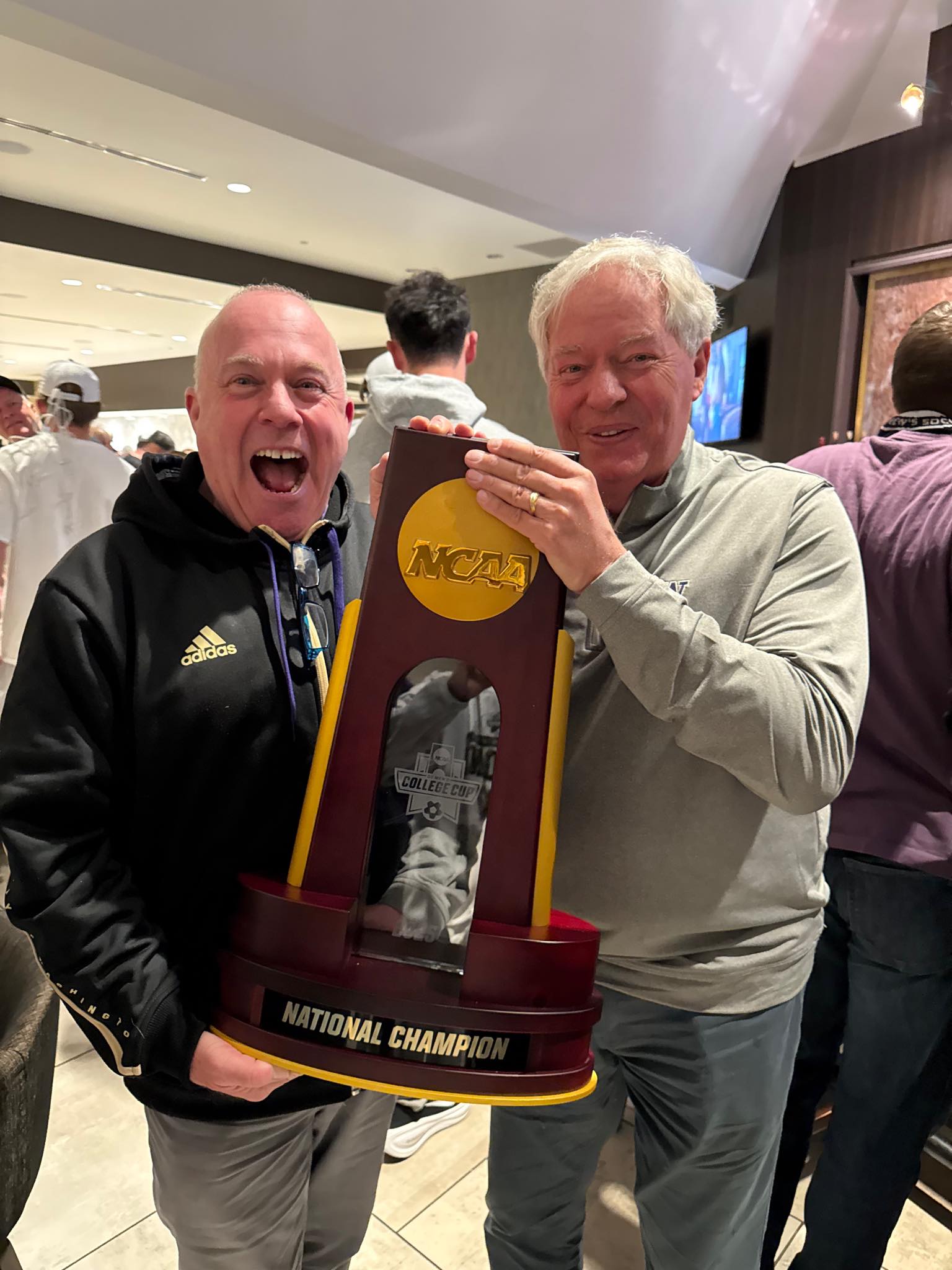
Marty Rood, right, and friend Peter Knowles pose with the trophy following the game. (Courtesy Martin Rood)

Much like the state’s past 13 collegiate champions at the Division II and NAIA levels, most of this Washington roster was homegrown. Seven of the starters and 10 of the 15 (19 in total) to see action at the College Cup finals hail from the state. That’s always been a hallmark of the Huskies (by comparison, N.C. State had 11 internationals and six in-state players).

Like Part of the Team

Continue reading One for All the Ages

Undercovered Husky Heritage

As the story goes, they spent at least one night before a big game sleeping in a barn. School colors were sometimes absent from their bargain basement jerseys. Occasionally, their coach might miss a match because he was making decent money parking cars at a classy Seattle restaurant.

Yet no one took the Washington Huskies lightly. These Huskies bonded tightly together, relishing their results achieved against formidable, better funded opponents. In fact, they once marched unscathed through an entire season to win a conference championship and later snapped the longest unbeaten streak in collegiate state history. They did so while not costing UW athletics a single dime.

The 15 years preceding the advent of varsity women’s soccer at Washington were full of lofty accomplishments and colorful characters in that self-funded club. The shame is that U-Dub leaders never saw fit to support them and, more than three decades later, their feats have gone unrecognized and have been largely forgotten.

Washington’s 1984 women’s club finished second to Western Washington’s varsity and ahead of three other varsity programs in the Northwest Collegiate Soccer Conference. (Jerome Rauen)

Family members around the world scour libraries and online archives to uncover their bloodlines and cultural heritage to better understand themselves. They develop a deeper sense of self, belonging and what has effectively sculpted their existence. They come to know, at least partly, why they are who they are.

While the official UW soccer record book starts with the first varsity team in 1991, here are stories of their forerunners, the club. They loved the game, and they enjoyed one another and playing for their school. Together, they were the outright first women of Washington Huskies soccer.

Absolute First All-American

Missing from that record book is the name of a future United States international. More than that, Denise Bender was the first player from any college in the state, male or female, to be voted All-America. Bender, who grew up on Mercer Island, started her studies and played for the pre-varsity club at Washington State. Along with her identical twin sister Laurie, who was a member of Western Washington’s varsity, they were voted all-Northwest Collegiate Soccer Conference defenders as freshmen and sophomores. Wazzu and Western shared the NCSC title in 1978.

Denise Bender became the first collegiate All-American from a Washington school following her first season with the UW club. (Courtesy Denise Bender)
Continue reading Undercovered Husky Heritage

The Road Not Taken

So much of life is like that Robert Frost poem, of two roads diverging. We muse about what might’ve happened by taking an alternate path; what would have “made all the difference.”

In our local soccer sphere, one particular path not taken was on Montlake. Where the world’s game was initially embraced by one University of Washington athletics administration, it was ignored by the next. Because of that neglect – or outright opposition – some observers contend Husky soccer has never achieved the heights for a school from a region so rich in natural resources.

If ever there was a golden era of girls and women in Washington state amateur soccer, it was the Eighties. Puget Sound was prolifically producing exceptional players who would go on to earn national and international recognition. Yet almost all would do so without ever matriculating through the university which might have offered the biggest mutual benefit for both player and school.

What might have been a UW all-decade selection for the 1980s. Just a sample, which includes future USWNT players, All-Americans and two Hermann Award winners.

Whereas some athletic directors across America saw the future, others clung to the past or their personal favorite. At Chapel Hill, the North Carolina athletic director, Bill Cobey, chose to start a varsity women’s soccer program in 1979. Cobey believed that by getting out in front of the sport, UNC could become a juggernaut. He hired one coach to cover both men and women. That coach, Anson Dorrance, made history and the Tar Heels’ legacy is unrivaled.

Continue reading The Road Not Taken

Washington’s Non-Varsity Blues

It was an invitation Mike Ryan could not refuse.

Wrapping up a training session in the fall of 1973, the University of Washington men’s coach was approached by a UW student, a young woman. She wanted to play soccer, and she wanted someone to coach a team of fellow Husky coeds.

Ryan was already coaching the Huskies plus youth and adult teams. He was a Dublin-born father of four and foundry worker who seemed to spend the rest of his waking hours growing the world’s game in his adopted homeland. Since arriving in Seattle in 1960, he had served as president of the Washington state men’s association and youth association. However, that addressed only half of the population.

Mike Ryan closely watching his Washington women in the late 70s. (Debbie Barlow)

Ryan agreed to serve as coach and his Irish brogue greeted Washington’s first female footballers. Few of them had any competitive athletic experience, let alone kicked a ball. He started them with the three-man weave drill, then another called Hit and Run. That first year the Huskies would play a jumbled schedule with such opponents as the Eastside Shamrocks, Green River Community College, Highline CC and the Capitol Hill Strikers.

Continue reading Washington’s Non-Varsity Blues

Jimmy Gabriel: The Gift of Lift

My adoration of Jimmy Gabriel is founded largely on a single half-hour shift and, really, just the first 10 minutes. My profound admiration of our first true Mr. Sounder lasts to this day.

Jimmy Gabriel may no longer walk this earth, but without question his legacy lives on. Every time Brian Schmetzer fills out a lineup sheet or delivers his team talk. Every time Bernie James addresses his kids. Every time Dean Wurzberger or Lesle Gallimore conduct a clinic. And so on and so on.

Jimmy Gabriel celebrates as the Sounders roar back to beat Portland in 1977. (Frank MacDonald Collection)

Our state soccer community thrives on so many fronts: Professional, college, amateur, youth and, of course, our legion of fans. For 20-25 years, Jimmy Gabriel was instrumental in the development of all those. Head coach, coaching director, assistant coach, volunteer: No matter the role, he found a means to contribute, sometimes forcefully, often times quietly. Not much for pomp, he led with his heart, and that’s when he won me over.

It was 1977, Jimmy’s first year after being elevated to head coach, and the Sounders were stumbling mightily out of the gate. Never mind that they lost the first three matches, they didn’t even score, and down 2-nil at home to Portland, Gabriel and the lads were staring at 0-4. Then everything changed.

Never to be Replicated

As a kid watching on TV some 90 miles away, Jimmy’s next act was unforgettable. It will never be replicated, either. Against our fiercest rival, he pulled off his track jacket, un-retired, inserted himself into the match and imposed his will upon the outcome.

Continue reading Jimmy Gabriel: The Gift of Lift

Live, Coast to coast

It was a big game, for sure. A chance for the Little School by the Canal to once again burnish its image as a collegiate soccer upstart. Oh, yeah, and have witnesses coast-to-coast.

Such was the set-up 40 years ago, when Seattle Pacific met Southern Illinois-Edwardsville in the second game of the 1979 season. The Falcons were defending NCAA Division II champion and SIUE arrived in Seattle ranked No. 4 in all the land, having reached the Div. I quarterfinals the previous season. And a new cable network, hungry for live content, saw fit to televise it.

SPU coach Cliff McCrath, left, next to opening goal-scorer Mark Metzger.

The yellowed newspaper clippings reference the Entertainment and Sports Programming Network. Before long, it would become known by its acronym, ESPN.

“We were told, and we believe it was the first soccer game televised by ESPN,” says Cliff McCrath, the legendary SPU coach. ESPN had only been on the air for four days by September 11. Cable TV was relatively new and not available in many neighborhoods in Seattle, so in some ways the broadcast was no big deal at the time.

Only 20 million U.S. homes had cable at the time, and just 1 million carried ESPN. In Puget Sound, Viacom and Teleprompter cable systems served 73,000 homes, though not all had – or were aware that they had – the new all-sports station whose first live game broadcast was from the Slow-Pitch Softball World Series.

Continue reading Live, Coast to coast

Mike Ryan: Seattle Soccer Is His Legacy

Note: This originally ran in The Seattle Times shortly after Mike Ryan’s passing, on Nov. 28, 2012.

Today’s local soccer landscape is associated with Hope Solo, Sounders FC and, yes, large, loud crowds. Yet to reach the zenith and become the continent’s capital of the sport required a huge amount of underpinning.

Mike Ryan was the first coach of the U.S. Women’s National Team.

Several unsung individuals have served as pillars, and none played a more prominent role than the late Mike Ryan. From his arrival in Seattle 50 years ago to his passing last week, Ryan went about building a foundation spanning virtually every area of the sport. Whether it’s youth, college, women’s or professional soccer across Puget Sound, you will find his handiwork.

“Mike did a world of good and Seattle soccer is his legacy,” says Jimmy McAlister, one of Ryan’s star pupils, a breakthrough professional and now Seattle United coaching director. ‘There are a lot of legendary players for the (original) Sounders, but we didn’t get this started. The cornerstones of this success were guys like Mike Ryan.”

Continue reading Mike Ryan: Seattle Soccer Is His Legacy