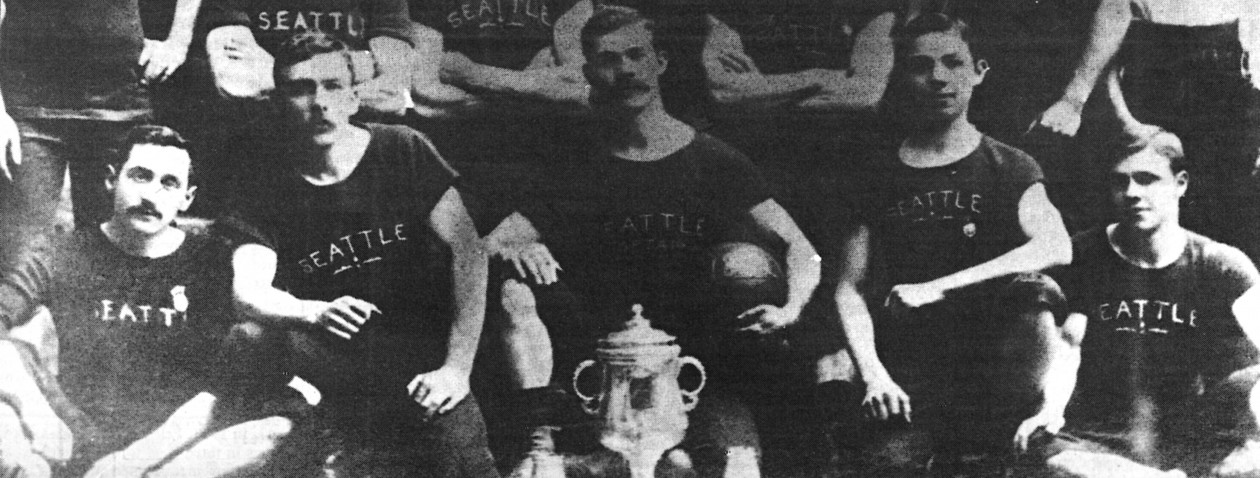
If there is to be a monument celebrating John Rowlands, it must stand tall and strong. It must exude tenacity, cunning and somehow exhibit a pinch of mischief.
For John Rowlands must be known for far more than just the goal that sounded our soccer community’s collective awakening. He was a buoyant, forceful personality; someone who would lead you headlong into the fray yet elicit some hardy laughs along the way. He was adventurous, striking out from his homeland for this faraway port to play for a side that had no prior existence. Here he would join, and in many ways lead, likeminded lads who blazed a path for what has become a thriving, footballing realm. He was a beacon.
John Rowlands, who led the line and, in many ways set the carefree tone of those first Sounders teams of the Seventies, has died, a victim of Coronavirus earlier this month in his native northwest England. He was 73.
John Rowlands, ca. 1974 (Frank MacDonald Collection)
Yet to the vast majority of contemporary footy followers around Seattle, the name Rowlands may fail to resonate. You might find a fuzzy image of him on YouTube or the black and white photographs such as those on this page. However, that’s all two-dimensional, and if one really wants to identify themselves a Sounder for life, let’s learn a bit about the late, great Sounder, John Rowlands.
Once John Best got a look at the narrow, crowned and unforgivingly hard Astroturf of Memorial Stadium, Seattle’s first coach envisioned the cast best equipped to win games in those cozy confines while at the same time winning fans. The plan: Those first Sounders would go direct, straight down the middle.
Professional sports is generally depicted as glamorous, a high life where players mix with other celebrities, relax at exotic and exclusive destinations and, all and all, lead a jet-set existence.
Truth be told, the majority of those being paid to perform
in the athletic arena are relatively simple folk who face many of the same
struggles of the common human. And while the rock star may flash a Rolex and
rumble off in a Lamborghini, the stories told by the rank and file are
interesting in their own right and, without question, more relatable.
Take the fishing story of Roger Levesque. Our smiling,
swashbuckling former Sounder forward is well-known for his pirate face and his
scuba celebration. But how many know that Levesque made his pro soccer life
possible by fishing the open sea?
For over 12 years, Levesque held a commercial fishing
license, working out of ports such as Astoria, Westport and Bellingham. Out
into the Pacific they’d sail in search of sablefish, a.k.a. black cod. When the
USL Sounders season ended, he would go out to sea where the catch enabled him
to make ends meet.
“I couldn’t buy a house or condo, and it was a huge
investment at the time,” explains Levesque, who took out a line of credit to
pay $90,000 for the license in 2006. “It helped bridge the gap.”
Thar he goes: Roger Levesque , commercial fisherman. During his USL and post-MLS days, he supplemented his income by catching black cod, a.k.a. sablefish, off the Washington and Oregon coasts. (Courtesy Roger Levesque)
Stormy Weather
In October, the weather can contribute to rough seas, and
Levesque and the crew would usually stay out 2-3 days until they reached their
limit. At times, it could take a week. They might sleep for a couple hours as
the lines soaked, but it could be 36 straight hours of demanding and sometimes
dangerous work.
There was not only a new head coach and GM but also
literally a ton of new players. And if Zach Scott thought he was the only
substitute schoolteacher among the lot of 2002 Sounders, the know-it-all student
in the front row would soon inform him. There was at least three.
However, Scott was probably the only player/teacher whose
Sounders career began by commuting 4-5 hours each way and who not only
graduated from college but got married within the first two months.
“I flew back to Maui for three days, we got married, and
then,” recalls Scott, “I flew back because we had a game that weekend.” All
that and no pay.
Having made Brian Schmetzer’s squad through a tryout, the
rookie from Gonzaga signed for the minimum. “We were getting $250 per game, if
you made it onto the field,” Scott confirms.
But in the first match following his nuptials, a one-sided
win over Hampton Roads, he never got off the bench.
Zach Scott progressed from first-year trialist to legend status after 15 seasons.
Those final years prior to Seattle joining MLS are
remembered for their four trophies and two extended runs and upsets in the Open
Cup. Yet as that A-League and USL era
fades in the rearview mirror, some may not comprehend just how lean was the
Sounders’ payroll.
Reminder: It’s A
Business
It should be noted that it’s unlikely Seattle would’ve
scored an MLS franchise, at least in 2007, had that USL club not existed. And
it only existed because Adrian Hanauer and fellow investors kept it afloat by
running a tight ship. Three pro soccer franchises in Seattle and Tacoma had
drowned in red ink, and when Hanauer became the managing partner the club was
coming off its worst finish for both attendance and league standing.
One evening, not so long ago, Peter Fewing was dining out with friends when a tablemate mentioned that Fewing once played professional soccer. It made him giggle, just a little.
When Jeff Stock first signed with the original Seattle
Sounders out of Tacoma’s Stadium High School, he wanted to maintain his amateur
status and eligibility for the 1980 Olympic Games. Still, his earnings, when
adjusted through an inflation calculator, were exponentially more than
Fewing’s. In fact, in 2020 dollars it exceeds that of some top players for
Reign FC today.
It’s madness, in many respects. But for those who have
played at the top levels of American pro soccer the past 45 years, this hardly
comes as a surprise. Any yet, none of the journeymen interviewed for this story
have many complaints. In fact, all maintain they were enriched by the
experience, intellectually if not financially.
“I was playing at the highest level of soccer in the country
at the time,” notes Fewing, now 26 seasons into a career as Seattle
University’s head coach. “It was fun, we had fans, we signed autographs, and we
got two free beers and a burger at the postgame party. The sentiment was that
we were having too much fun to complain.”
It all began as a working vacation for David Gillett. In 1974, the 23-year-old Scotsman first stepped foot in Seattle, where pro soccer had never existed. He was coming to play central defense, but Gillett was soon all-in as a missionary for this emerging sport, conducting clinics and making plentiful promotional appearances.
Back in Britain, where he played for Crewe Alexandra, the
job was pretty much two hours of daily training, with a match or two each week.
It had been much the same for Adrian Webster when playing
for his hometown club of Colchester, in England. He moved to Vancouver to play
semi-pro and then heard about the NASL coming both there and Seattle soon
after.
“I was very fortunate that it was the Sounders and John Best
and Jimmy Gabriel that I played under,” Webster offers. “Not all of the clubs
in the NASL were run as professionally.” Soon Webster was starting on the
backline with Gillett, and the city adored their new team and their tradition
of applauding the fans each night from the center circle.
The original Seattle Sounders, pictured in 1974. Adrian Webster is front row, third from left; David Gillett is back row fourth from right. (Frank MacDonald Collection)Continue reading Land of Opportunity→
In 1944 – at the height of WWII – Italian POWs arrived in Puget Sound. Their Allied captors allowed many freedoms, including formation of multiple teams in Washington state amateur soccer’s top division.
On the evening of April 17, 1945, players, coaches, sponsors and officials of the Washington State Football Association gathered at Seattle’s stylish Olympic Hotel to celebrate winners of the various competitions held during the preceding six months. During the social hour, guests undoubtedly discussed the latest news of the world, of which there was no shortage. World War II was being waged in two theaters, and while an Allied victory appeared at hand in Europe, President Franklin Roosevelt would not live to see it. Five days earlier Roosevelt had died from a massive stroke, and now the United States had a new leader, commander-in-chief, Harry Truman.
Aerial view of Fort Lawton, taken in 1965, 20 years after World War II ended. In 1973 , much of its 534 acres in Seattle’s Magnolia neighborhood was given to the city and became Discovery Park. (Courtesy City of Seattle Municipal Archives)
Since
the bombing of Pearl Harbor, news of the war had been inescapable. It dominated
headlines and everyday dialogue. Now the war was having a profound effect upon
the state’s top amateur league, evidenced by the parade to the podium to
pick-up the WSFA trophies. A previously non-existent club was being presented
three pieces of silverware, including the ancient (1906) McMillan Cup.
At
the end of this day, members of this triumphant team would not go home. Instead
they would be remanded to their supervising officer and returned to their
barracks. Known as the 28th Italian Service Unit, these were officially
prisoners of war. Prisoners of a onetime enemy. Prisoners with privileges, yet
prisoners just the same.
A
World Power (On the Pitch)
Just 10 years earlier, Italian football had announced itself on a much larger stage. Without question, the Azurri were the Team of the Thirties, making a triumphant entrance to World Cup play by not only hosting the tournament but also becoming the first European nation to claim it. From that date until the outbreak of World War II, no national team was more revered than Italy which followed with a gold-medal performance at the 1936 Summer Olympics and another World Cup victory in 1938. During that stretch they ran roughshod, winning 38 and drawing six in 48 full internationals. Such success only served to further fuel a dictator’s desire for a new Roman empire.
Poster promoting Italy hosting the 1934 FIFA World Cup.
Benito Mussolini wanted the Azurri to be the embodiment of his Fascist movement, exhibiting a strength, cunning and physicality reflective of the new, merging Italy. As noted in David Goldblatt’s The Ball Is Round, the national team was exploited, used as a tool to create a warlike spirit. The manager later said, however, that players were generally not interested in their play making a political statement. They loved the game. Soon enough, however, war was a reality.
A Beating on Battlefield
Mussolini
joined Hitler’s Nazi Germany and Japan in forming the Axis powers yet was
comparatively ill-equipped, undermanned and poorly trained. Many soldiers were
unwilling combatants. Consequently, Italy took repeated beatings on the
battlefield.
Many
of these unenthusiastic conscripts to Mussolini’s army were among the 200,000
taken prisoner by the Allies in May 1943 following the Battle of Tunisia. If
being shot at and losing comrades while fighting for a deluded dictator was not
sufficiently demoralizing, some Italian prisoners were subjected to torture and
starvation under a blazing sun by Tunisian guards. Allied forces eventually divvied
up the POWs, and by January 1944 over 50,000 were bound for detention in the
United States. Some, however, would soon be given privileges previously
unheard-of.
It was a big game, for sure. A chance for the Little School by the Canal to once again burnish its image as a collegiate soccer upstart. Oh, yeah, and have witnesses coast-to-coast.
Such was the set-up 40 years ago, when Seattle Pacific met Southern Illinois-Edwardsville in the second game of the 1979 season. The Falcons were defending NCAA Division II champion and SIUE arrived in Seattle ranked No. 4 in all the land, having reached the Div. I quarterfinals the previous season. And a new cable network, hungry for live content, saw fit to televise it.
SPU coach Cliff McCrath, left, next to opening goal-scorer Mark Metzger.
The yellowed newspaper clippings reference the Entertainment and Sports Programming Network. Before long, it would become known by its acronym, ESPN.
“We were told, and we believe it was the first soccer game televised by ESPN,” says Cliff McCrath, the legendary SPU coach. ESPN had only been on the air for four days by September 11. Cable TV was relatively new and not available in many neighborhoods in Seattle, so in some ways the broadcast was no big deal at the time.
Only 20 million U.S. homes had cable at the time, and just 1 million carried ESPN. In Puget Sound, Viacom and Teleprompter cable systems served 73,000 homes, though not all had – or were aware that they had – the new all-sports station whose first live game broadcast was from the Slow-Pitch Softball World Series.
In American soccer, it ain’t easy to know your history. So many fits and starts; it’s been a sport interrupted, and often the second act forgets the first.
Locally, unless it’s St. Louis or the swath of pitches
stretching from Philadelphia north and east to Boston, soccer’s past is likely
buried in an attic, far from public consumption.
That goes for the great soccer state of Washington, as well.
We could begin chipping away at our own Rushmore with hall of fame players like
Akers, Higgins and Keller, yet most are unaware that five prior inductees were
among those who poured the foundation of what was to come.
Nowadays, of course, the multitude of fans supporting
Sounders FC are world-class and, consequently, have grabbed the world’s
attention and made Washington impossible to ignore. Still, the footing for this
fan base, this pipeline of top-class footballers and our undying love for the
game has been left unexplored. Until now.
Washington State Legends of Soccer is bringing this history back to life. There’s enough to fill a few hundred pages in a book, but time marches on and more and more history is being made. So, instead WA Legends is telling tales through a legacy platform designed by Seattle’s DCGone. There, visitors from across the globe can dive headlong into a pool of knowledge about Washington, whose roots in the game extend back some 130 years, practically to our territorial days.
Professional sports travel in North America can be arduous what with all the time zones and long distances between destinations.
But sometimes the road is where a team discovers itself, its character. Within the confines of airliners, buses, hotel rooms and shared meals can come a newfound camaraderie. Constant interaction can act as an incubator, speeding the development of relationships, on and off the field. Of course, this all assumes the chemistry elements are correct in the first place.
The Reign just returned home after playing four consecutive road matches. They have seven more points than when they last played at Memorial.
The Sounders, meanwhile, are outbound to a pair of imposing away matches at Toronto and Portland. The Reds have apparently sorted things out and are coming off a 3-0 win over Philly. The Timbers have won three straight, scoring six goals in their last two home wins.
What’s been Rave and white and red all over? Ah, that would describe the inauspicious start to the Sounders’ MLS season so far.
Two games, two red cards; no goals, no points. Even for historically slow-starting Seattle, this is a bit unsavory for the faithful. But when referees are showing cards, might as well go all-in. In other words, let’s dive in to an anecdotal history of notable Sounders walks of shame.
First Impressions
In the beginning, there was Dave D’Errico. Seven games into the original Sounders’ existence and, personally, just his second appearance, top draft pick D’Errico decked Toronto’s Gene Strenicer. It did not go undetected. While D’Errico sat in the locker room, Davey Butler scored late to give 10-man Seattle the road victory.
Tommy Jenkins no sooner arrived in Seattle than he saw red flash before his eyes.
Newly-imported from England, Tommy Jenkins was billed as an elegant playmaker to support Geoff Hurst. Yet when the pair debuted in 1976 at St. Louis, Jenkins introduced himself to the NASL by getting stuck-in, way in. He saw red then, but never again in his four seasons. Three other openers were marked excessive force, most recently Tony Alfaro’s double yellow versus LAFC.
Early? You want an early shower? Leo Gonzalez had barely broken a sweat in Columbus before his seventh-minute sending off in 2013. You probably don’t remember that; instead that game is best known for Eddie Johnson’s winner, celebrated by his ‘show-me-the-money’ mime.