All posts by Frank MacDonald

Pedigree suggests I had no future in soccer. Our town had no youth program, let alone a high school team. So we started our own club. Then I had a mercifully brief tryout at the University of Washington. Apart from an intramural championship and several seasons in the state league, that's it. Nevertheless, the game intrigues me to this day. Some days it's tactics and player combinations. But mostly it how the game connects the people on this planet and marks time. Nothing has ever come easily for soccer in America. Failures abound. But if the mark of a champion is getting knocked down only to climb back to your feet, then it there's a real possibility fùtbol will not only persevere but flourish. I've tried to do my part, be it as a paying fan, a journalist, a publicist or historian based in the nation's soccer capital, Seattle. So this blog serves as an outlet to share what I've collected from 30-some years in around the sport in these parts, as well as the shared experience of going forward together.

How Legends Are Made

There was not only a new head coach and GM but also literally a ton of new players. And if Zach Scott thought he was the only substitute schoolteacher among the lot of 2002 Sounders, the know-it-all student in the front row would soon inform him. There was at least three.

However, Scott was probably the only player/teacher whose Sounders career began by commuting 4-5 hours each way and who not only graduated from college but got married within the first two months.

“I flew back to Maui for three days, we got married, and then,” recalls Scott, “I flew back because we had a game that weekend.” All that and no pay.

Having made Brian Schmetzer’s squad through a tryout, the rookie from Gonzaga signed for the minimum. “We were getting $250 per game, if you made it onto the field,” Scott confirms.

But in the first match following his nuptials, a one-sided win over Hampton Roads, he never got off the bench.

Zach Scott progressed from first-year trialist to legend status after 15 seasons.

Those final years prior to Seattle joining MLS are remembered for their four trophies and two extended runs and upsets in the Open Cup.  Yet as that A-League and USL era fades in the rearview mirror, some may not comprehend just how lean was the Sounders’ payroll.

Reminder: It’s A Business

It should be noted that it’s unlikely Seattle would’ve scored an MLS franchise, at least in 2007, had that USL club not existed. And it only existed because Adrian Hanauer and fellow investors kept it afloat by running a tight ship. Three pro soccer franchises in Seattle and Tacoma had drowned in red ink, and when Hanauer became the managing partner the club was coming off its worst finish for both attendance and league standing.

Continue reading How Legends Are Made

Got Game, Will Travel

Sometimes following your dream means leaving town, again and again. For a couple of Seattle native sons, they started at home and finished here. But in between they moved around a lot.

Chance Fry and Peter Hattrup both came out of local high schools in 1982, when the sun was still high in the sky for American soccer. It would go dark all too quickly.

That summer there were 28 teams, both outdoor and indoor, that were paying livable wages across the continent. Within two years, that number was cut in half, and when Fry and Hattrup reached their prime, pro soccer in this corner of the earth, after years of bleeding red ink, all but went black.

Hattrup refers to his peer group as The Lost Generation. They may have made some bucks, even gotten a taste of MLS or made a World Cup squad. Yet there’s long been a lingering question of what might’ve been.

If there was a silver lining, says Hattrup, the game was overflowing with players and coaches with an unquenchable thirst to find a game. Any game. “The great thing was you only had guys that loved to play,” he claims. “No one did it just for themselves, just for the money. They loved being part of the game.”

The Sounders drafted Chance Fry as a Sammamish High School senior and U.S. Youth National Team player.

An Auspicious Start

Continue reading Got Game, Will Travel

Too Much Fun to Complain

One evening, not so long ago, Peter Fewing was dining out with friends when a tablemate mentioned that Fewing once played professional soccer. It made him giggle, just a little.

When Jeff Stock first signed with the original Seattle Sounders out of Tacoma’s Stadium High School, he wanted to maintain his amateur status and eligibility for the 1980 Olympic Games. Still, his earnings, when adjusted through an inflation calculator, were exponentially more than Fewing’s. In fact, in 2020 dollars it exceeds that of some top players for Reign FC today.

It’s madness, in many respects. But for those who have played at the top levels of American pro soccer the past 45 years, this hardly comes as a surprise. Any yet, none of the journeymen interviewed for this story have many complaints. In fact, all maintain they were enriched by the experience, intellectually if not financially.

“I was playing at the highest level of soccer in the country at the time,” notes Fewing, now 26 seasons into a career as Seattle University’s head coach. “It was fun, we had fans, we signed autographs, and we got two free beers and a burger at the postgame party. The sentiment was that we were having too much fun to complain.”

Craig Beeson, left, and Peter Fewing , center, celebrate an FC Seattle goal. (Joanie Komura photo/Frank MacDonald Collection)
Continue reading Too Much Fun to Complain

Land of Opportunity

It all began as a working vacation for David Gillett. In 1974, the 23-year-old Scotsman first stepped foot in Seattle, where pro soccer had never existed. He was coming to play central defense, but Gillett was soon all-in as a missionary for this emerging sport, conducting clinics and making plentiful promotional appearances.

Back in Britain, where he played for Crewe Alexandra, the job was pretty much two hours of daily training, with a match or two each week.

It had been much the same for Adrian Webster when playing for his hometown club of Colchester, in England. He moved to Vancouver to play semi-pro and then heard about the NASL coming both there and Seattle soon after.

“I was very fortunate that it was the Sounders and John Best and Jimmy Gabriel that I played under,” Webster offers. “Not all of the clubs in the NASL were run as professionally.” Soon Webster was starting on the backline with Gillett, and the city adored their new team and their tradition of applauding the fans each night from the center circle.

The original Seattle Sounders, pictured in 1974. Adrian Webster is front row, third from left; David Gillett is back row fourth from right. (Frank MacDonald Collection)
Continue reading Land of Opportunity

Freedom to Play

In 1944 – at the height of WWII – Italian POWs arrived in Puget Sound. Their Allied captors allowed many freedoms, including formation of multiple teams in Washington state amateur soccer’s top division.

On the evening of April 17, 1945, players, coaches, sponsors and officials of the Washington State Football Association gathered at Seattle’s stylish Olympic Hotel to celebrate winners of the various competitions held during the preceding six months. During the social hour, guests undoubtedly discussed the latest news of the world, of which there was no shortage. World War II was being waged in two theaters, and while an Allied victory appeared at hand in Europe, President Franklin Roosevelt would not live to see it. Five days earlier Roosevelt had died from a massive stroke, and now the United States had a new leader, commander-in-chief, Harry Truman.

Aerial view of Fort Lawton, taken in 1965, 20 years after World War II ended. In 1973 , much of its 534 acres in Seattle’s Magnolia neighborhood was given to the city and became Discovery Park. (Courtesy City of Seattle Municipal Archives)

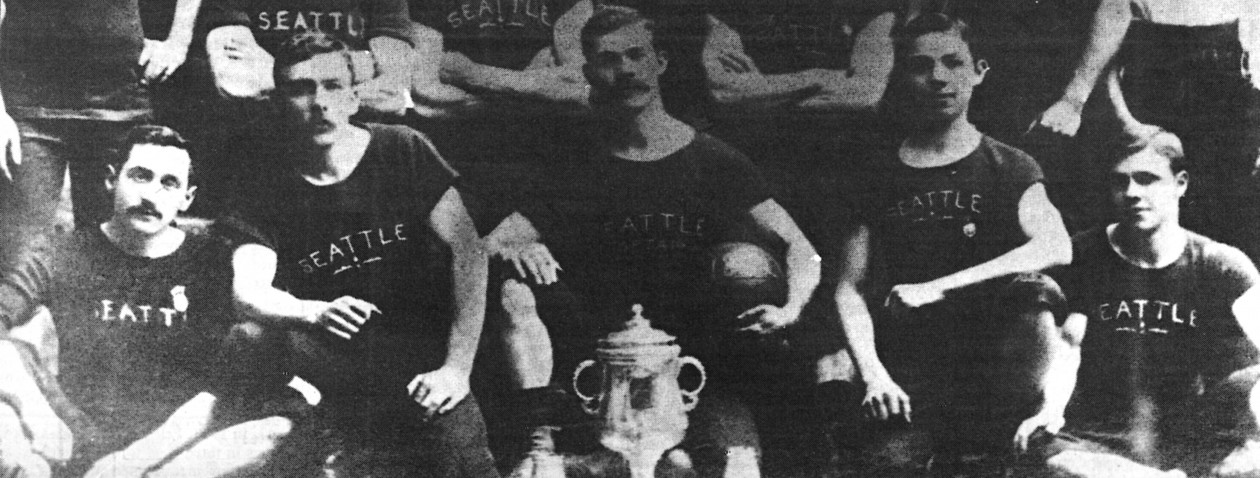
Since the bombing of Pearl Harbor, news of the war had been inescapable. It dominated headlines and everyday dialogue. Now the war was having a profound effect upon the state’s top amateur league, evidenced by the parade to the podium to pick-up the WSFA trophies. A previously non-existent club was being presented three pieces of silverware, including the ancient (1906) McMillan Cup.

At the end of this day, members of this triumphant team would not go home. Instead they would be remanded to their supervising officer and returned to their barracks. Known as the 28th Italian Service Unit, these were officially prisoners of war. Prisoners of a onetime enemy. Prisoners with privileges, yet prisoners just the same.

A World Power (On the Pitch)

Just 10 years earlier, Italian football had announced itself on a much larger stage. Without question, the Azurri were the Team of the Thirties, making a triumphant entrance to World Cup play by not only hosting the tournament but also becoming the first European nation to claim it. From that date until the outbreak of World War II, no national team was more revered than Italy which followed with a gold-medal performance at the 1936 Summer Olympics and another World Cup victory in 1938. During that stretch they ran roughshod, winning 38 and drawing six in 48 full internationals. Such success only served to further fuel a dictator’s desire for a new Roman empire.

Poster promoting Italy hosting the 1934 FIFA World Cup.

Benito Mussolini wanted the Azurri to be the embodiment of his Fascist movement, exhibiting a strength, cunning and physicality reflective of the new, merging Italy. As noted in David Goldblatt’s The Ball Is Round, the national team was exploited, used as a tool to create a warlike spirit. The manager later said, however, that players were generally not interested in their play making a political statement. They loved the game. Soon enough, however, war was a reality.

A Beating on Battlefield

Mussolini joined Hitler’s Nazi Germany and Japan in forming the Axis powers yet was comparatively ill-equipped, undermanned and poorly trained. Many soldiers were unwilling combatants. Consequently, Italy took repeated beatings on the battlefield.

Many of these unenthusiastic conscripts to Mussolini’s army were among the 200,000 taken prisoner by the Allies in May 1943 following the Battle of Tunisia. If being shot at and losing comrades while fighting for a deluded dictator was not sufficiently demoralizing, some Italian prisoners were subjected to torture and starvation under a blazing sun by Tunisian guards. Allied forces eventually divvied up the POWs, and by January 1944 over 50,000 were bound for detention in the United States. Some, however, would soon be given privileges previously unheard-of.

Continue reading Freedom to Play

Big Crowd. Big Cause.

Without question the best, most dramatic match I ever witnessed live was played before less than 1,500 fans and ended near midnight. The largest crowd to which I was a party was for a scoreless affair under a scorching midday sun. And five of the eight biggest attendances for matches played in Seattle didn’t matter at all.

That’s what makes this coming Sunday such a beautiful convergence of the masses with the most meaningful afternoon of footy our state has ever seen. When the first whistle pierces the mid-autumn air for Sounders v Toronto, CenturyLink Field will be teeming with people who came to be part of history, part of a unique experience in Seattle sporting culture: One game to determine the champion of an 8-month marathon known as MLS.

No doubt, that’s what sparked the run on tickets, fans seeking to seize the moment. When the Reds took down Atlanta and soon after the ticket link went live to season ticket holders, no one needed a clever hashtag or promotional gimmick to go online. Seattle became a soccer capitol long, long ago; like their playing heroes, the fans are smart and opportunistic, and soon the lower bowl inventory was exhausted, and folks took aim on getting tickets for friends in the upper deck. Within 48 hours, the CLink was full-up.

Bigger match, bigger crowd. It stands to reason.

The Kingdome’s first sporting event, a Sounders friendly vs. New York Cosmos, was also the first U.S. soccer attendance of 50,000 or more.
Continue reading Big Crowd. Big Cause.

Live, Coast to coast

It was a big game, for sure. A chance for the Little School by the Canal to once again burnish its image as a collegiate soccer upstart. Oh, yeah, and have witnesses coast-to-coast.

Such was the set-up 40 years ago, when Seattle Pacific met Southern Illinois-Edwardsville in the second game of the 1979 season. The Falcons were defending NCAA Division II champion and SIUE arrived in Seattle ranked No. 4 in all the land, having reached the Div. I quarterfinals the previous season. And a new cable network, hungry for live content, saw fit to televise it.

SPU coach Cliff McCrath, left, next to opening goal-scorer Mark Metzger.

The yellowed newspaper clippings reference the Entertainment and Sports Programming Network. Before long, it would become known by its acronym, ESPN.

“We were told, and we believe it was the first soccer game televised by ESPN,” says Cliff McCrath, the legendary SPU coach. ESPN had only been on the air for four days by September 11. Cable TV was relatively new and not available in many neighborhoods in Seattle, so in some ways the broadcast was no big deal at the time.

Only 20 million U.S. homes had cable at the time, and just 1 million carried ESPN. In Puget Sound, Viacom and Teleprompter cable systems served 73,000 homes, though not all had – or were aware that they had – the new all-sports station whose first live game broadcast was from the Slow-Pitch Softball World Series.

Continue reading Live, Coast to coast

Reign vs Thorns: By the Numbers (2013- )

NWSL Era – Reign vs Thorns (2013- ) [as of 8/11/2025]

League

Home (form): 9-4-3 GD: 25-12 [LLWWDWWLWWWWDLDW]

Away: 5-7-3 GD: 15-21 [LLWLWDLDWLWWDLL]

Neutral 0-0-0 GD: 0-0

Total: 14-11-6 GD: 40-33 [LLLLWWLWWDDLWDWLWWLWWWWWDDLLDWL]

Playoffs

Home: 0-0-0 GD: 0-0

Away: 0-1-0 GD: 1-2 [L]

Total: 0-1-0 GD: 1-2 [L]

Summer Cup

Home:  0-0-0

Away:  0-1-0 GD: 0-1 [L]

Total:  0-1-0 GD: 0-1 [L]

Challenge Cup (incl. Fall ’20)

Home:  0-1-2 GD: 2-3 [LDD]

Away:  2-2-0 GD: 3-6 [LLWW]

Neutral: 0-0-1 GD: 0-0 [D]

Total:  2-3-3 GD: 4-9 [DLDWWD]

Extremes

Record Win: 5-0, Memorial Stadium, 7/27/2014

Record Defeat: 1-4, Providence Park, 9/30/2020

Record Total Goals:  6, Portland 4:2 Seattle, 8/10,2025

Doubles (win home & away same season): 4/2

Top Attendance

Home: 42,054 (6/3/2023)

Away: 25,218 (9/16/2023)

Individual Leaders

Goals: 11–Christine Sinclair (P); 9-Megan Rapinoe (S); 5–Lindsay Horan (P), Beverly Yanez (S); 3–Jess Fishlock (S), Hina Sugita (P), Kim Little (S), Jodie Taylor (S), Bethany Balcer (S)

Hat Tricks: None

Multi-Goal Games: 3–Christine Sinclair (P); 2–Megan Rapinoe (S); 1–Lindsay Horan (P), Manon Melis (S), Hayley Raso (P), Beverly Yanez (S)

Assists: 5–Jess Fishlock (S); 4–Kim Little (S); 3–Sophia Smith (P), Naho Kawasumi (S), Beverly Yanez (S), Lindsey Horan (P), Meghan Klingenberger (P); 2–Allie Long (P/S), Megan Rapinoe (S), Mana Shim (P), Christine Sinclair (P), Shirley Cruz (S)

3-Assist Game: Sophia Smith (P)

Multi-Assist Games: 2–Kim Little (S); 1–Theresa Nielsen (S), Lindsey Horan (P), Sophia Smith (P)

Shutouts:  4– Haley Kopmeyer (S) 4; 4–Bella Bixby (P); 3–Casey Murphy (S), 3–Shelby Hogan (P), 3–Michelle Betos (P/S); 2–Laurel Ivory (S), 2–Karina LeBlanc (P), 2–Claudia Dickey (S); 1–Nadine Angerer (P), Hope Solo (S), Lydia Williams (S), Adriana Franch (P), Phallon Tullis-Joyce (S)

Appearances: 36–Lauren Barnes (S); Christine Sinclair (P); 29-Jess Fishlock (S); 28–Meghan Klingenberg (P); 25–Emily Menges (P), 23–Allie Long (P/S); 20–Bethany Balcer (S); 19-Beverly Yanez (S); 17-Lindsey Horan (P); 17-Megan Rapinoe (S), 17–Kelli Hubly (P); 15–Sofia Huerta (S), 14–Stephanie Cox (S); 13–Morgan Weaver (P), 13-Keelin Winters (S), 12-Kiersten Dallstream (S), 12–Mana Shim (P); 11–Olivia Moultrie (P

Coaching Records:  Cindy Cone (P) 4-0-0; Laura Harvey (S) 9-12-8; Paul Riley (P) 1-4-0; Vlatko Andonovski (S) 5-2-0; Mark Parsons (P) 7-9-5; Farid Benstiti (S) 1-3-1; Rhian Wilkinson (P) 0-1-2; Mike Norris (P) 2-1-1, Rob Gale (P) 3-1-1

Sent off: None

Notes

On Aug. 29, 2021, the Reign and Thorns played as part of a doubleheader with Sounders-Timbers at Lumen Field, with the Reign establishing a new NWSL single game attendance record of 27,278. That record fell in 2023 with 42,054 for another Reign-Sounders doubleheader.

#KnowYourHistory Just got Easier

In American soccer, it ain’t easy to know your history. So many fits and starts; it’s been a sport interrupted, and often the second act forgets the first.

The WA Legends landing page, designed by Palador.

Locally, unless it’s St. Louis or the swath of pitches stretching from Philadelphia north and east to Boston, soccer’s past is likely buried in an attic, far from public consumption.

That goes for the great soccer state of Washington, as well. We could begin chipping away at our own Rushmore with hall of fame players like Akers, Higgins and Keller, yet most are unaware that five prior inductees were among those who poured the foundation of what was to come.

Nowadays, of course, the multitude of fans supporting Sounders FC are world-class and, consequently, have grabbed the world’s attention and made Washington impossible to ignore. Still, the footing for this fan base, this pipeline of top-class footballers and our undying love for the game has been left unexplored. Until now.

Washington State Legends of Soccer is bringing this history back to life. There’s enough to fill a few hundred pages in a book, but time marches on and more and more history is being made. So, instead WA Legends is telling tales through a legacy platform designed by Seattle’s DCGone. There, visitors from across the globe can dive headlong into a pool of knowledge about Washington, whose roots in the game extend back some 130 years, practically to our territorial days.

Continue reading #KnowYourHistory Just got Easier

Arlo Across America

For an Englishman, Arlo White sure gets around. America, that is.

White has been an Americanophile for over 30 years, beginning with a boyhood trip to Chicago to visit his great aunt. He kept coming back, and then in 2010 began broadening his travel as Sounders broadcaster and, beginning in 2012, as lead commentator for NBCSN coverage of MLS.

His work for the network’s Premier League coverage has since taken him back home to Leicester but a piece of his heart always seems to drum to the beat of a Yankee. He spends his summer holidays exploring the country with his wife and twin daughters. This year was no exception, and he’s already plotting a 2019 return to where this TV business all started.

Dedicated to his craft, White is always prepared for the worst and exuberant for the best. Now beginning his sixth season of EPL play-by-play, he says he’s altered his style, but only slightly, and believe he and NBC have found their groove.

 Almost 10 years into working on TV, do you find that you’ve changed your approach in any way?

In terms of preparation, it’s exactly the same, with a few tweaks. At the start there was possibly more statistics. Now that I’ve grown into the League and the role, it’s probably more about storylines. If I can add a nice quote that gets a conversation started or makes a point, it lets the players or the manager dictate the storyline rather than me shoehorning something into a game.

White’s detailed preparation is ready for the worst of times.

Continue reading Arlo Across America