All posts by Frank MacDonald

Pedigree suggests I had no future in soccer. Our town had no youth program, let alone a high school team. So we started our own club. Then I had a mercifully brief tryout at the University of Washington. Apart from an intramural championship and several seasons in the state league, that's it. Nevertheless, the game intrigues me to this day. Some days it's tactics and player combinations. But mostly it how the game connects the people on this planet and marks time. Nothing has ever come easily for soccer in America. Failures abound. But if the mark of a champion is getting knocked down only to climb back to your feet, then it there's a real possibility fùtbol will not only persevere but flourish. I've tried to do my part, be it as a paying fan, a journalist, a publicist or historian based in the nation's soccer capital, Seattle. So this blog serves as an outlet to share what I've collected from 30-some years in around the sport in these parts, as well as the shared experience of going forward together.

One for All the Ages

When Washington’s winner bulged the back of the net, it was as if it was wired with an electrical charge capable of instantly zapping purple-clad alumni across the continent and back through the ages.

Not only was it pandemonium on the Washington bench but also in the rec rooms of UW players and coaches and fans spanning seven decades. Stabbing his close range shot between post and N.C. State keeper, Harry Bertos finally, after 63 seasons, pushed the Huskies over the hump and into the elite circle of NCAA champions on Dec. 15.

Ron Jepson, Washington’s first head coach, watches the Huskies’ NCAA championship celebration from Bellingham. (Courtesy Ron Jepson)

Scattered across the Northwest and nation were some 600 former players and coaches, now fans, who were watching the national final on their phones and rec room screens. Up in Bellingham, the UW men’s soccer program’s first coach spontaneously defied gravity.

“We jumped up off our seats,” exclaimed Ron Jepson of his family’s reaction. It was a “momentous occasion,” added Jepson, the coach of UW’s first varsity team. An engineering graduate student from England, he was handed Washington’s reins in October 1962, when the nearest collegiate competition was in Victoria and Vancouver.

Euphoria in Carolina

While Jepson was 2,947 miles away from the drama in Cary, N.C., Marty Rood was in the house at WakeMed Soccer Park. Rood, who played under Mike Ryan in the early Seventies, had flown from Seattle on the morning of the match, arriving in Raleigh a couple hours before kickoff, to join the scores of UW traveling fans dwarfed by the 10,000 cheering the hometown Wolfpack.

Rood stood alongside other alums spanning the seven decades of Husky soccer and found himself hoarse from support and celebrations going long into the night.

“This win was more euphoric than any in my years of soccer,” shared Rood. “It just didn’t seem they would lose…they just never gave up. They were relentless!”
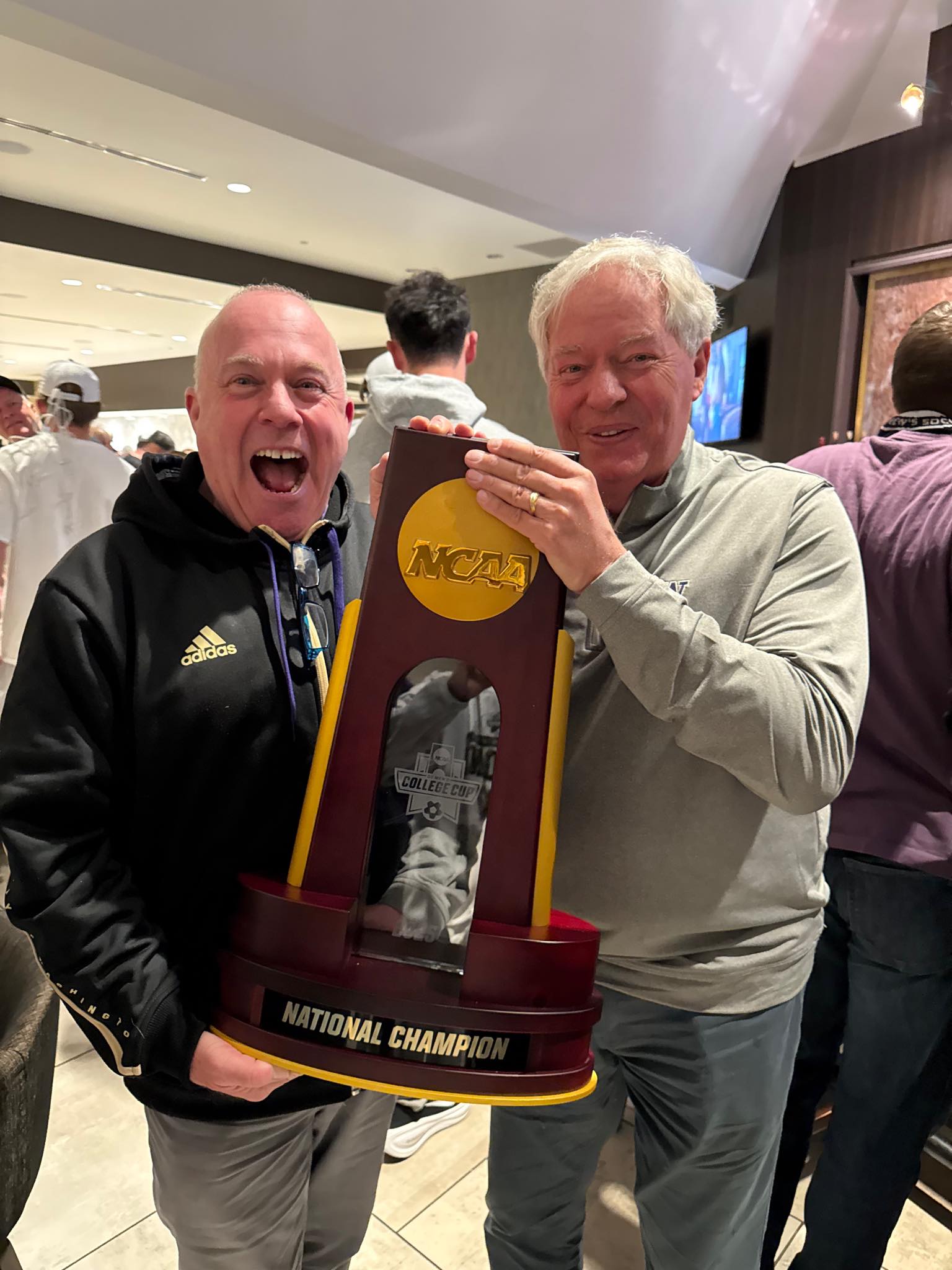
Marty Rood, right, and friend Peter Knowles pose with the trophy following the game. (Courtesy Martin Rood)

Much like the state’s past 13 collegiate champions at the Division II and NAIA levels, most of this Washington roster was homegrown. Seven of the starters and 10 of the 15 (19 in total) to see action at the College Cup finals hail from the state. That’s always been a hallmark of the Huskies (by comparison, N.C. State had 11 internationals and six in-state players).

Like Part of the Team

Continue reading One for All the Ages

Undercovered Husky Heritage

As the story goes, they spent at least one night before a big game sleeping in a barn. School colors were sometimes absent from their bargain basement jerseys. Occasionally, their coach might miss a match because he was making decent money parking cars at a classy Seattle restaurant.

Yet no one took the Washington Huskies lightly. These Huskies bonded tightly together, relishing their results achieved against formidable, better funded opponents. In fact, they once marched unscathed through an entire season to win a conference championship and later snapped the longest unbeaten streak in collegiate state history. They did so while not costing UW athletics a single dime.

The 15 years preceding the advent of varsity women’s soccer at Washington were full of lofty accomplishments and colorful characters in that self-funded club. The shame is that U-Dub leaders never saw fit to support them and, more than three decades later, their feats have gone unrecognized and have been largely forgotten.

Washington’s 1984 women’s club finished second to Western Washington’s varsity and ahead of three other varsity programs in the Northwest Collegiate Soccer Conference. (Jerome Rauen)

Family members around the world scour libraries and online archives to uncover their bloodlines and cultural heritage to better understand themselves. They develop a deeper sense of self, belonging and what has effectively sculpted their existence. They come to know, at least partly, why they are who they are.

While the official UW soccer record book starts with the first varsity team in 1991, here are stories of their forerunners, the club. They loved the game, and they enjoyed one another and playing for their school. Together, they were the outright first women of Washington Huskies soccer.

Absolute First All-American

Missing from that record book is the name of a future United States international. More than that, Denise Bender was the first player from any college in the state, male or female, to be voted All-America. Bender, who grew up on Mercer Island, started her studies and played for the pre-varsity club at Washington State. Along with her identical twin sister Laurie, who was a member of Western Washington’s varsity, they were voted all-Northwest Collegiate Soccer Conference defenders as freshmen and sophomores. Wazzu and Western shared the NCSC title in 1978.

Denise Bender became the first collegiate All-American from a Washington school following her first season with the UW club. (Courtesy Denise Bender)
Continue reading Undercovered Husky Heritage

The Road Not Taken

So much of life is like that Robert Frost poem, of two roads diverging. We muse about what might’ve happened by taking an alternate path; what would have “made all the difference.”

In our local soccer sphere, one particular path not taken was on Montlake. Where the world’s game was initially embraced by one University of Washington athletics administration, it was ignored by the next. Because of that neglect – or outright opposition – some observers contend Husky soccer has never achieved the heights for a school from a region so rich in natural resources.

If ever there was a golden era of girls and women in Washington state amateur soccer, it was the Eighties. Puget Sound was prolifically producing exceptional players who would go on to earn national and international recognition. Yet almost all would do so without ever matriculating through the university which might have offered the biggest mutual benefit for both player and school.

What might have been a UW all-decade selection for the 1980s. Just a sample, which includes future USWNT players, All-Americans and two Hermann Award winners.

Whereas some athletic directors across America saw the future, others clung to the past or their personal favorite. At Chapel Hill, the North Carolina athletic director, Bill Cobey, chose to start a varsity women’s soccer program in 1979. Cobey believed that by getting out in front of the sport, UNC could become a juggernaut. He hired one coach to cover both men and women. That coach, Anson Dorrance, made history and the Tar Heels’ legacy is unrivaled.

Continue reading The Road Not Taken

Washington’s Non-Varsity Blues

It was an invitation Mike Ryan could not refuse.

Wrapping up a training session in the fall of 1973, the University of Washington men’s coach was approached by a UW student, a young woman. She wanted to play soccer, and she wanted someone to coach a team of fellow Husky coeds.

Ryan was already coaching the Huskies plus youth and adult teams. He was a Dublin-born father of four and foundry worker who seemed to spend the rest of his waking hours growing the world’s game in his adopted homeland. Since arriving in Seattle in 1960, he had served as president of the Washington state men’s association and youth association. However, that addressed only half of the population.

Mike Ryan closely watching his Washington women in the late 70s. (Debbie Barlow)

Ryan agreed to serve as coach and his Irish brogue greeted Washington’s first female footballers. Few of them had any competitive athletic experience, let alone kicked a ball. He started them with the three-man weave drill, then another called Hit and Run. That first year the Huskies would play a jumbled schedule with such opponents as the Eastside Shamrocks, Green River Community College, Highline CC and the Capitol Hill Strikers.

Continue reading Washington’s Non-Varsity Blues

The Absolute Beginning

Eight members of the first U.S. Women’s National Team were from Washington. On Aug. 18, the Reign celebrates the 40th anniversary of their historic debut.

They were the first. And whatever has happened since – the four world championships and five Olympic golds – was truly achieved on the shoulders of The 85ers.

Long before the country flipped on the spotlight switch for the U.S. Women’s National Team, these figures strode wide-eyed onto a world stage.  We would like to believe that they were ready for the moment, that summer afternoon along the Adriatic. But in truth, in 1985 the United States was not ready for prime time. A frugal federation saw to that.

Opening ceremonies for the 1985 Mundialito in Jesolo, Italy. (Courtesy Mike Ryan)

They hired a coach but took another two years to scratch together enough funds for a few days of preparation and some surplus men’s kits before sending their inaugural women’s team against an assemblage of Europe’s most talented and tested.

Queens for a Night

Honoring The 85ers is the centerpiece of the Seattle Reign’s Queens Night on Monday, August 18, the 40th anniversary of the USWNT debut match in Jesolo, Italy. It’s a celebration and, for many of the attendees, a homecoming.

Mike Ryan, the coach, lived in Lake City. Eight of his players hailed from the Puget Sound. What’s more, that maiden voyage could well have started in Seattle. Three months before the Mundialito, FC Seattle announced a tournament involving the USWNT, West Germany and England to be held Aug. 7-12 at Memorial Stadium. Alas, weeks later it fell apart.

Denise Bender (l) playing for Seattle’s PCI Sharks, 1980 U.S. Amateur champions. (Soccer America/Frank MacDonald Collection)

Back in 1985, the national team’s existence was largely overlooked by the media and public. Only in 1996, when attracting large crowds during the Atlanta Summer Games, did the media take notice. The 85ers have only begun receiving greater recognition in the past two years, beginning with a 2023 reunion in Asheville, N.C., followed with a 2024 celebration in Kansas City.

“This reunion is special because almost half of that team was from Washington,” said Denise Bender, the ’85 team captain who grew up on Mercer Island. “The Washington State Women’s Soccer Association and the Washington State Soccer Association were strong advocates for us to get seed money for travel to tournaments and playing on a visible platform. We couldn’t have done all that by just selling candy bars.”

Continue reading The Absolute Beginning

Review: ‘Girls with Goals’

A few times during the first thousand words my eyebrows arched when a new nugget of information was dropped. But it was page 16 when Girls with Goals began raising my blood near the boiling point.

Not only do I have a wife, daughter, mother and two sisters, for more than two decades during my life I have worked with girl’s and women’s athletics. I was in junior high when Title IX became law and a young father by the time I worked the 1999 FIFA World Cup. I was well aware of the enduring grind for equal rights leading up to that triumphant final before a record throng in the Rose Bowl.

Yet on page 16 of Clelia Castro-Malaspina’s history of women’s soccer, she details the early meetings between England and Scotland picked teams, in 1881.

She writes: “Many people – mostly men – showed up to watch them, but not so much as fans. They were there to gawk and heckle and yell obscene things. There seemed to be anger in the air among the male attendees over the fact that women were playing ‘their’ sport. At two separate matches, rowdy spectators stormed the field. That’s right, the earliest female footballers were literally chased off the soccer field by men.”

It’s Been a Long, Long Journey

If you’re an amateur footy historian believing that the long slog to respect had taken most of your lifetime, you now had to accept that for at least two more generations women had been facing this open resistance to them joining the game. Boomers can recall a cringe-worthy Virginia Slims cigarette advertisement from the late Sixties, about women having come a long way, “to get where you’ve got to, today.” And in chapter upon chapter Castro-Malaspina, a player herself, illustrates that the war on women’s soccer dates back a long, long, long time – all the way back to the late 19th Century.

Readers of Girls with Goals will become engrossed early on, then frustrated by the fits and starts, and finally –  finally! – vindicated by progress in the events of the last decade, namely two World Cup championships, plus equal pay. This is a book that should be circulated among every team, every class and every library and especially those populated by young teens.

“I wrote this book for anyone who loves women’s soccer (and that’s a lot of people!),” Castro-Malaspina wrote to me, “but the real target audience are girls who are like whom I was when I was a teenager – the girls who love to play soccer and/or who are huge fans of the USWNT and the NWSL. As a girl this book would have been the most important book in my library, and I really believe this book can hold a lot of meaning for many young girls and women.”

Continue reading Review: ‘Girls with Goals’

Thanks for the Memories, Memorial

It would be 90 miles each way and I was a year away from a driver’s license. Tickets were student-priced at $2.50 but the seats were view obstructed. Yet I was determined to finally see with my eyes what I had only imagined in my mind.

As it turns out, Sunday, June 29, marks 50 years since I first saw a Seattle Sounders game firsthand. Officially, it was sold-out, except for these seats whose vantage point continually had spectators straining to see around the substantial concrete pillars. I paid cash from my lawn mowing earnings and convinced my sister to make the long drive from Centralia to Seattle to see our first professional soccer contest at Memorial Stadium.

Memorial Stadium at its peak, during the Sounders’ first two NASL seasons. (Frank MacDonald Collection)

If there was any question whether I would be consumed by this game, it was answered in those first minutes after taking our seats. One by one, the Sounders starters were announced over the loudspeaker and the crowd stood and roared.

The atmosphere in Memorial on a summer evening was magical. Between the steep rake of the permanent stands, the twin concrete roofs of the two sideline stands and the extra 6,000 bleachers filling every bit of spare space, the feeling was intimate and the noise incredible. As it turned out, I was hooked. For life.

A Beautiful Backdrop

At its best, Memorial was a big city cracker box where the sport could shine. Fifty years ago from next Saturday came the first nationally televised Sounders game, against Pelé and the Cosmos. It had the look and feel of a Soccer Specific Stadium because, in those early days, it was compact and a scarcity of tickets; the final 17 home games were all filled to capacity.

Continue reading Thanks for the Memories, Memorial

The 47 Factor

He calls it “God’s sense of humor.” Others contend it’s coincidence. It’s objectively known as The 47 Factor, and it somehow figured into each of Seattle Pacific University’s five NCAA Championships under coach Cliff McCrath.

McCrath adopted his lucky number upon joining the Wheaton College soccer team in 1955. He was issued an old football jersey bearing the number 47. He went on to become a three-time All- American and wore a 47 on his shirts throughout his 38 seasons as men’s coach.

In 1978, the Falcons won their first NCAA Championship, scoring a huge upset over No. 1 Alabama A&M. The time of the deciding goal: 126:47. In 1983, Seattle Pacific captured a second title by toppling top-ranked Tampa. At the time McCrath was 47 years of age. SPU took home its third trophy in ’85 by clipping Florida International, 3-2. It marked McCrath’s 470th game as coach.

Continue reading The 47 Factor

Small But Mighty

College soccer in the Pacific Northwest had only just begun. The season was short, the coaches part-time and there was precious little fan support or media coverage. There were scores and standings and not much else. Yet, as for those latter two categories, unfashionable Western Washington State College’s men’s club program cast an outsized shadow.

Now, some 55 years later, let the record show that, a) it did happen, b) it was no fluke, and c) there is a story to tell of the small but mighty Vikings and their four-year rule over frustrated varsity foes who were confounded by a band of students who funded their own trips, lined their own fields and largely picked their own lineups.

While being high achievers, the Western men of yore were never accused of taking themselves too seriously or over-training. In fact, they won admiration from opponents and Western varsity athletes who recognized their qualities, both on and off the pitch. They were more than teammates; they were tightknit friends and remain so to this day. More than anything, that might’ve been the secret to their success.

A League of Their Own

As athletic director of the state’s most established and resourced men’s soccer program, Joe Kearney must have envisioned that the new conference he was founding would only fortify that status. The University of Washington could now adjust its sights on competing for national recognition.

Ahead of the 1968 season, Kearney, the Huskies’ AD, had cobbled together the four-school Western Washington Soccer Conference, the first of its kind in the Pacific Northwest. He also would serve as commissioner. Joining UW would be newly launched varsity programs at Seattle University and Seattle Pacific, plus the student-organized club from Western Washington.

Action from the 1969 season (Western Front archives)

All credit to Kearney, who unlike his successor, demonstrably cared about non-revenue-producing programs such as soccer. It had taken a couple years for the sport to reach critical mass to create a league. But back then, if anyone had asked Kearney or anyone else what they would predict for the formative first few years of the WWSC, it would’ve been Washington as overwhelmingly perennial favorite, with Seattle U. and Seattle Pacific to follow.

Continue reading Small But Mighty

Soccer Stories of Old Seattle: Something to Chew On

Some 40 years ago, while at the University Book Store, I crossed paths with a book like none other. After consuming many a book about soccer tactics, skills and history, The Soccer Tribe was about the game’s rituals, its participants and its followers. Written by noted British zoologist Dr. Desmond Morris, it studied human beings through the footy lens.

The Soccer Tribe took a macro approach to observing people who surround the game. In Soccer Stories of Old Seattle and Around the World, it is a more nuanced, micro examination by author and Seattle native Phil Davis and co-contributor Bob Smith.

From July 23 through July 27, 2024, electronic copies of Soccer Stories of Old Seattle and Around the World will be available free of charge from Amazon. Davis asks that in lieu of a payment during that period, readers consider making a donation to Washington State Legends of Soccer, either for its scholarship fund or ongoing initiatives.

Davis shares tales of places he’s visited, people he’s met or discovered – all at the intersection of soccer and life.   

Asked about his newly published book’s message, Davis writes that in a country and world that often presents itself as deeply divided, “Friendship between different kinds of people is possible. So is world peace, or at least the end of long wars,” he added. “We practice every four years with the World Cup. All that is needed is a sporting attitude, a few rules developed by Thomas Aquinas 850 years ago, and the beautiful game.”

Continue reading Soccer Stories of Old Seattle: Something to Chew On